RisingStar's Commitment to Visual Excellence
In the display industry, the difference between a "decent" screen and a "premium" one lies in uniformity.
This means that the image should appear equally bright and have a consistent color across its entire surface.
Even if a screen has high resolution, if shadows, spots, or lighter areas appear, the visual quality is perceived as inferior.
At RisingStar, they eliminate the Mura Effect problem through rigorous engineering, the selection of Grade A+ panels, and industry-leading testing protocols.
What is the Mura Effect?
The term "Mura" comes from Japanese and means irregularity or unevenness.
In LCD displays, it refers to visual imperfections that cause certain areas to appear darker, lighter, or with a different texture.
We can compare it to painting a wall: even if you use the same paint, if you apply more paint to one area than another, the result will look uneven. On a screen, this happens microscopically, but the human eye perceives it.
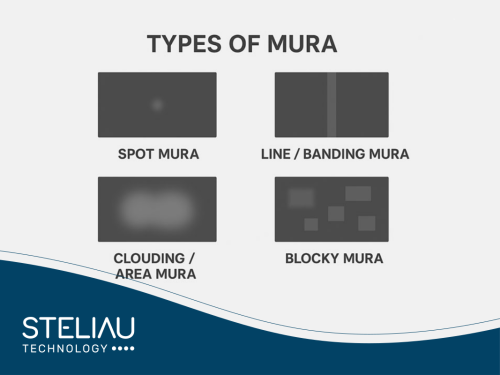
These irregularities can manifest as:
- Clouding: lighter or darker areas on uniform backgrounds, such as night scenes.
- Banding: horizontal or vertical lines that break the uniformity.
- Spots or dots: small areas with brightness or a different color than the rest.
Main Causes of the Mura Effect
- Layer Variation: The liquid crystal layer of each pixel must have a perfectly uniform thickness (only a few microns). If it has even the slightest unevenness, the light passes through changes, creating areas with different brightness.
- Backlight Stress: LCD panels use an LED backlight. If these are not properly distributed or if the diffuser does not distribute the light evenly, brighter or dimmer areas will appear.
- Impurities or material defects: Tiny dust particles or irregular electric fields can alter the orientation of the liquid crystals, causing spots or color differences. The best analogy to visualize this problem is to think of a calm lake that perfectly reflects the sky. If small stones are thrown into the water, the ripples distort the reflection. Something similar happens inside the LCD panel when there are impurities or microscopic variations.
The RisingStar Testing Protocol: The “Double-Check” Standard
To ensure that no visual defects reach the customer, RisingStar applies a triple inspection process, called the Double-Check Standard:
Phase/Time/Action
Stage 1 – Reception (Upon arrival of open panels) Complete inspection of panels from LG, BOE, and AUO.
Stage 2 – Post-Aging (After 72 hours) Mandatory aging cycle (“burn-in”) is performed to stabilize the panel and detect defects that appear with use.
Stage 3 – Pre-Shipping (Before packaging) Final double test is performed by independent quality engineers, both visual and digital.
Advanced Mura Detection Methods
We combine human evaluation with precision optical instrumentation:
Type Appearance Typical Cause
- Clouding Areas with varying brightness Backlighting or irregular diffusion
- Banding Horizontal or vertical lines Voltage variations or response times
- Spotting Spotted areas that are lighter or darker Impurities in the liquid crystal
- Mura Noise Small fluctuations or irregular shadows Microscopic pixel misalignment
Professional Solutions to the Mura Effect
Ensuring perfect uniformity requires a combination of process improvement and technological advancement:
- Process optimization: Millimetric control of temperature, pressure, and layer alignment to reduce variations.
- Advanced quality control: Mura testing at various stages of production, not just at the end.
- Compensation algorithms: Software that dynamically adjusts the electrical signal of each area to balance brightness.
- Optical diffusing films: special layers that even out backlighting and reduce the visibility of defects.
Why Choose RisingStar?
At RisingStar, we are committed to a flawless viewing experience, free from distractions and defects.
- Direct supply: genuine panels from LG, BOE, and AUO.
- Guaranteed A+ quality: We never use refurbished or lower-grade panels.
- Proven reliability: Every screen undergoes a complete 72-hour aging cycle and a final double test before shipping.
Our goal: to ensure every screen is perfect before it reaches the customer.
Article based on the RisingStar publication located at:
https://www.risinglcd.com/news/How-the-Mura-Effect-Impacts-LCD-Quality-A-Professional-Guide.html